
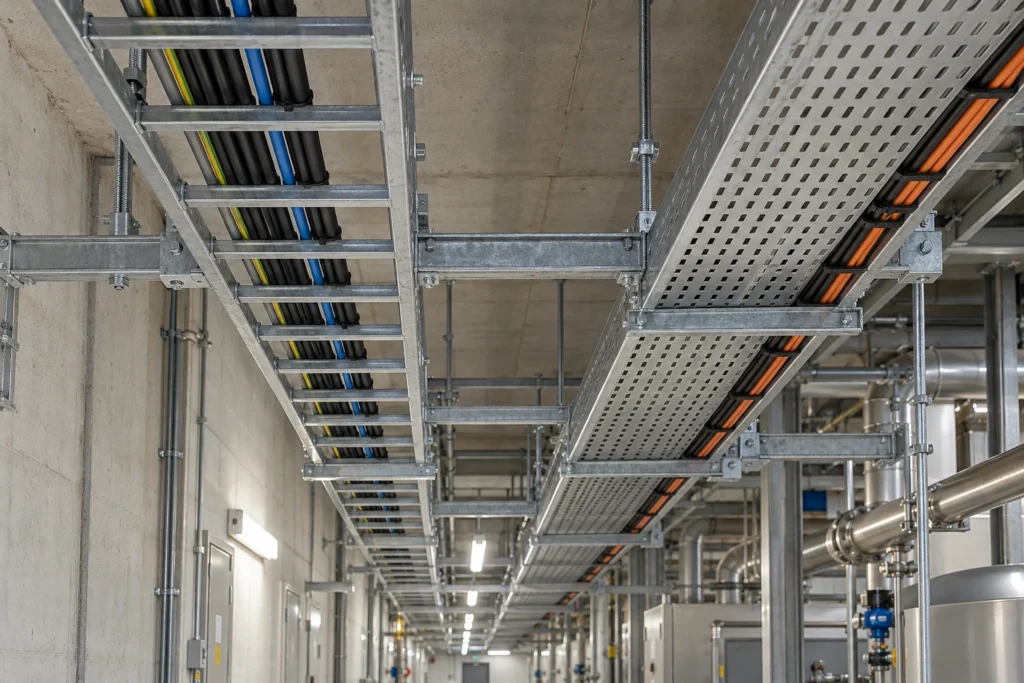
Quick Answer: Choose a cable tray manufacturer in India by matching the tray type perforated, ladder, or GI to your cable load, route, and site environment, confirming compliance with IEC 61537:2023, and comparing suppliers on the same written scope covering accessories, supports, finish, documentation, and delivery. Indian manufacturers offer advantages in drawing coordination, customization, and logistics for projects across the country, but product suitability must always be verified against project requirements.
Introduction
Cable trays are easy to overlook when planning a plant or commercial project. Yet they support cable routes, keep wiring organised, and make later inspection or expansion easier. Choosing the right tray depends on the cables, the route, the environment, and the supports—not just the tray price.
If you are comparing a cable tray manufacturer in India, this guide explains the common tray types, what to check in the project specification, and how to compare suppliers fairly. Whether your project is in Gujarat, Maharashtra, Tamil Nadu, Karnataka, or any other state, the same evaluation framework applies. Anubhav Techno Solutions manufactures from Sachin GIDC, Surat, and supplies cable tray systems to industrial and commercial projects across India.
Why Choose an Indian Cable Tray Manufacturer?
An Indian cable tray manufacturer offers practical advantages for domestic projects: faster drawing discussions in the same time zone, easier factory visits and sample verification, simpler coordination on custom fabrication, and shorter logistics chains for delivery.
For buyers, the most valuable benefit is access to the fabrication floor. When the manufacturer is in India, you can review material grades, galvanising thickness, bend quality, and welding finish before dispatch something that is difficult to verify with imported trays until they arrive. Indian manufacturers also tend to be more responsive to mid-project route changes, since revisions do not involve international shipping cycles.
That said, “Made in India” alone is not a quality claim. The supplier’s material specification, finish control, testing documentation, and scope clarity still determine whether the tray suits your project. Use the same checklist for every cable tray supplier in India you evaluate, and compare quotations line by line.
For a broader view of how cable management integrates with the rest of a facility, see Anubhav’s cable management system fabrication capability.
Common Types of Cable Trays
Cable trays in Indian industrial and commercial projects fall into three main categories: perforated, ladder, and GI (galvanised) trays. The right choice depends on cable type, load, ventilation needs, and environment not a one-size-fits-all rule.
Perforated Cable Tray
A perforated cable tray has openings along its base. The openings can help with airflow and drainage, while the tray supports cables across a continuous surface. It is often considered for control, instrumentation, and general cable routing, depending on the cable load and installation conditions.
Perforated trays provide continuous support for small or mixed cable bundles and offer better physical protection than open ladder designs. They are widely used in control rooms, instrumentation runs, IT and data facilities, and light industrial plants across India. Check that the opening pattern, side height, and width suit the cables and the fixing method planned for the project. For product details, view Anubhav’s perforated cable tray range.
Ladder Cable Tray
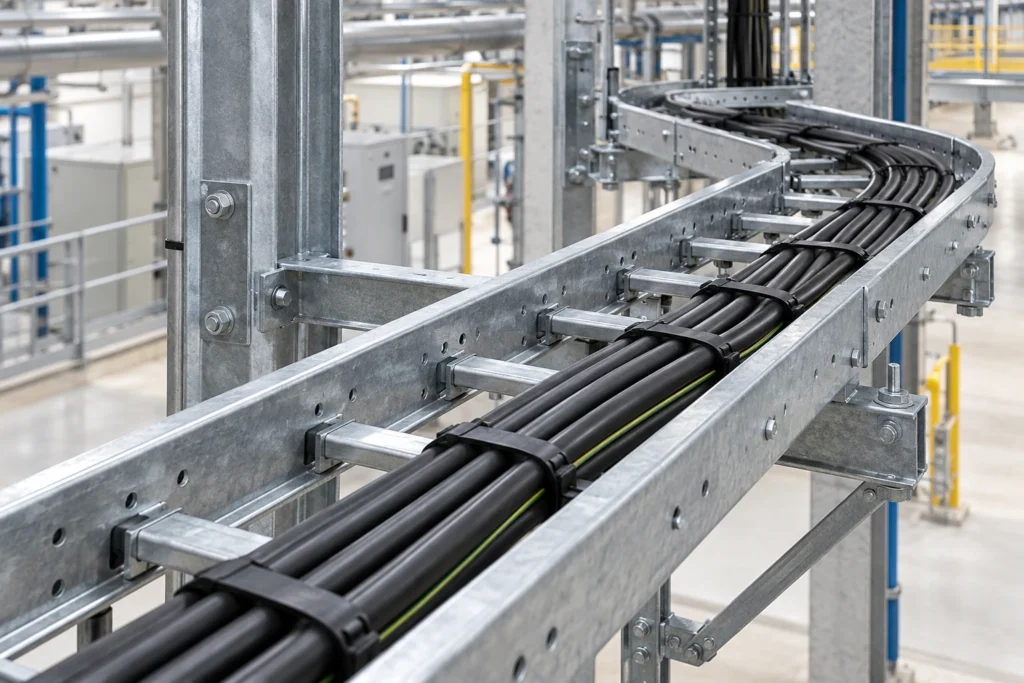
A ladder cable tray has two side rails connected by rungs. Its open structure gives installers access to cables and can provide airflow around them. It may be suitable for heavier cable runs or routes with longer support spans, but the correct size and support spacing must be based on the actual load and design.
Ladder trays typically carry heavier distributed loads often in the 75–200 kg/m range under IEC 61537 classifications while perforated trays suit lighter systems in the 25–75 kg/m range. Ladder designs also maximise ventilation for power cables where heat dissipation affects ampacity. These are common in power plants, heavy manufacturing, cement, steel, and large infrastructure projects. Ask the supplier to confirm the proposed loading information for the specified arrangement. See Anubhav’s ladder cable tray offering.
GI Cable Tray
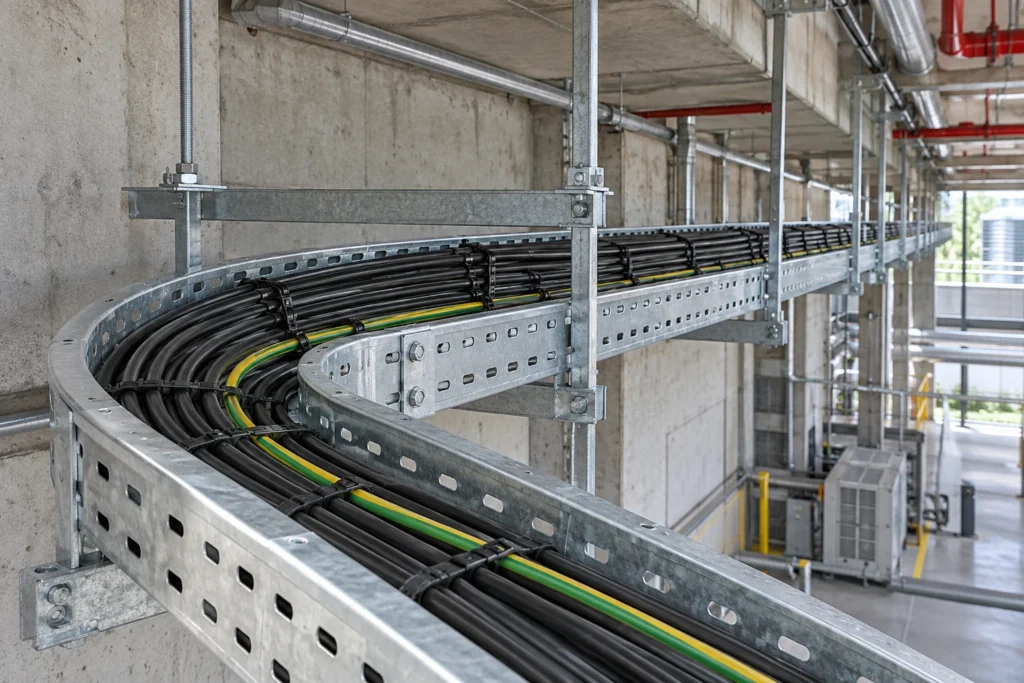
“GI” commonly refers to galvanised iron or galvanised steel in product descriptions. Galvanised finishes are selected to suit the expected exposure and project requirements, but the word “GI” alone does not tell you the coating method, thickness, or corrosion performance. Ask the manufacturer to state the material and finish clearly in the quotation and confirm that they are appropriate for the site environment.
Hot-dip galvanising and pre-galvanised (GP) sheet are not the same thing—hot-dip offers substantially thicker zinc coating and is preferred for outdoor, coastal, or chemically exposed routes. Review Anubhav’s GI cable tray specifications and confirm the coating method in writing before ordering.
Local Insight: Manufacturing Base in Surat, Supply Across India
Anubhav Techno Solutions fabricates cable trays from its Sachin GIDC, Surat facility—positioned within Gujarat’s chemical, textile, pharmaceutical, and port-linked industrial belt. This location offers two advantages for pan-India buyers: access to a mature fabrication and galvanising supply chain, and proximity to national transport corridors for dispatch to Maharashtra, Madhya Pradesh, Rajasthan, Delhi-NCR, Tamil Nadu, Karnataka, and other markets. For projects in Gujarat’s coastal and chemical belt (Surat, Hazira, Ankleshwar, Vadodara), the same facility supports faster sample review, site visits, and delivery coordination.
Some projects use more than one tray type. For example, the main route may use a ladder tray while branches or smaller cable groups use perforated sections. The choice should follow the route design and cable requirements rather than a one-size-fits-all rule.
Standards, Materials, and Project Requirements
Standards are useful only when they match the product and project scope. IEC 61537:2023 is the primary international standard covering requirements and tests for cable tray systems and cable ladder systems used to support and accommodate cables. It does not cover cable trunking or cable ducting systems, which can look similar in a catalogue. Confirm which product category is being quoted and which standard your project specification calls for.
Indian projects frequently reference IEC 61537 alongside consultant specifications, approved make lists, and client-specific requirements. Do not assume that a general reference to a standard means every project requirement is covered, or that a supplier holds a particular certification. Ask for the relevant test information, product details, and documentation for the proposed system.
Material and Finish Selection
Material and finish selection depends on the installation environment. Galvanised steel, stainless steel, or aluminium may be considered for different conditions:
- Hot-dip galvanised steel — general industrial, outdoor, and moderately corrosive environments
- Stainless steel (SS 304 / SS 316) — chemical plants, coastal sites, food and pharmaceutical facilities, high-humidity areas
- Aluminium — lighter structures where reduced weight matters and corrosion resistance is adequate
Compare the environment, mechanical demands, compatibility with the rest of the installation, and maintenance expectations. The manufacturer should describe the offered material and finish rather than relying on a broad label.
For projects that also involve electrical panels, Anubhav’s electrical and data enclosure fabrication follows the same material and finish discipline. If your scope includes standards verification, the CPRI certification and quality assurance process is a useful reference for how test documentation is handled in Indian projects.
How to Choose a Cable Tray Manufacturer in India
A capable supplier should be able to understand the route and provide a clear, itemised proposal. When you speak with a cable tray supplier in India, share drawings or a route sketch if available, along with the project location and cable information. Then compare the responses using the same criteria.
Use this checklist to compare suppliers fairly:
- Product fit: Does the proposed tray type, width, side height, and finish match the drawings and site conditions?
- Load and supports: Are the cable load assumptions and support spacing stated or confirmed by the responsible designer? Many Indian project specifications use support spacing in the range of 1.0 m to 1.5 m for horizontal runs, but the final spacing must come from the project’s structural design, not a generic figure.
- Accessories: Are bends, tees, reducers, covers, connectors, and supports included where the route needs them?
- Fabrication details: Are dimensions, thickness, finish, and any custom requirements written clearly in the quotation?
- Quality information: What inspection records, test information, or material details can be supplied for the project?
- Delivery and logistics: Are quantities, packaging, delivery location, lead time, transport responsibility, and any phased deliveries confirmed?
- Changes: How will drawing revisions or changes to the route be priced, approved, and scheduled?
These questions make it easier to compare like with like. If a quotation is shorter or cheaper, check whether it excludes accessories, supports, or a particular finish before treating it as the better option.
Pan-India Delivery and Project Logistics
For projects outside the manufacturer’s home state, confirm packaging standards, dispatch method, and whether the consignment will travel as full truckload or part-load. Cable trays are prone to bending and finish damage in transit, so ask how sections will be bundled, stacked, and protected. Clarify whether delivery is to site or to a project store, and who bears unloading responsibility.
For a wider view of supplier evaluation, see Anubhav’s guide on choosing the right electrical panel for different industries the same scope-comparison discipline applies to cable trays.
Why Work With Anubhav Techno Solutions
Anubhav Techno Solutions Pvt. Ltd. (ATSPL) manufactures GI, ladder, and perforated cable trays at its Sachin GIDC, Surat facility and supplies projects across India. The company’s cable management offering includes custom fabrication to project drawings, so tray widths, side heights, bend configurations, and finish specifications can be matched to the actual route rather than selected from a standard catalogue.
ATSPL also operates as an authorised Havells distributor, which simplifies procurement when trays, panels, switchgear, and accessories form part of the same project package. For buyers managing multiple vendors, consolidating cable management and electrical supply with one partner reduces coordination overhead.
Share your route requirements and ask the team to confirm product details, material, finish, accessories, and documentation for your specific project. You can review the full cable management product range before requesting a configuration-specific quote.
Video Insight: Visualise Fabrication Before You Order
Watching a fabrication walkthrough makes tray selection easier to evaluate. Ask your shortlisted manufacturer for a short process video covering shearing, bending, welding, galvanising, and dispatch—or search YouTube for “cable tray fabrication India” and “ladder vs perforated cable tray installation” to compare how different designs handle bends, supports, and cable entry in real projects. A supplier that can share clear visual documentation is typically better prepared to support site coordination across states.
Questions to Ask Before Placing an Order
Use these questions to get clear written answers from any cable tray manufacturer in India:
Que 1. Which tray type and finish are you proposing, and why?
Ans: This confirms whether the recommendation is based on your cable load and environment or simply on what the factory prefers to make.
Que 2. What cable load and support spacing have been assumed?
Ans: Load assumptions should be stated, not left for the installer to discover on site.
Que 3. Which accessories and supports are included in the price?
Ans: Bends, tees, reducers, covers, and supports can materially change the total cost.
Que 4. What product or test documents will be provided?
Ans: Confirm whether material test certificates, inspection records, or IEC 61537–related test information are included.
Que 5. When does the quoted delivery period begin?
Ans: Clarify whether the clock starts from the order date or from drawing approval.
Que 6. How will the material be packaged and transported to my site?
Ans: Confirm bundling, protection against finish damage, transport responsibility, and unloading scope.
Que 7. How will changes to the route or drawings be handled?
Ans: A written change process prevents disputes after fabrication begins.
Clear written answers help the installer, buyer, and supplier work from the same plan. Keep the approved drawings and final quotation together, and make sure any later revision is shared with everyone involved.
Frequently Asked Questions
Which are the main cable tray types available from manufacturers in India?
Indian manufacturers typically supply perforated trays, ladder trays, and GI (galvanised) trays, along with wire mesh trays and raceways in some cases. Perforated trays suit control and instrumentation cables, ladder trays suit heavier power runs and longer spans, and galvanised finishes address corrosion according to site exposure.
Is a perforated tray always better for ventilation?
Not necessarily. Openings can support airflow, but the right choice depends on cable type, route, exposure, mechanical protection, and project requirements. Perforated trays provide moderate ventilation and continuous support, while ladder trays maximise airflow for heavy power cables. Ask the designer to confirm the selection.
When should I consider a ladder tray?
A ladder design may be considered for routes needing an open structure or support for larger cable runs. Ladder trays typically carry heavier loads over longer spans and are often used for main power routes in plants and infrastructure projects. The designer or supplier should check the actual load, span, and support arrangement for the application.
What standard applies to cable trays in India?
IEC 61537:2023 is the primary international standard for cable tray and cable ladder systems, and Indian project specifications frequently reference it alongside consultant requirements and approved make lists. Always confirm which edition and which product scope apply to your order.
What is the difference between GI and hot-dip galvanised cable trays?
“GI” is a broad label that may refer to pre-galvanised sheet or hot-dip galvanised steel. Hot-dip galvanising applies a substantially thicker zinc coating and is generally preferred for outdoor, coastal, and chemically exposed routes. Ask the manufacturer to state the coating method and thickness in the quotation rather than accepting “GI” alone.
Can an Indian manufacturer supply cable trays to projects in other states?
Yes. Most established Indian manufacturers dispatch nationwide. Confirm packaging standards, transport responsibility, delivery to site or store, unloading scope, and whether delivery will be in one shipment or phased before finalising the order.
What should I send when requesting a quote?
Send the route drawings or sketch, tray type if specified, dimensions, material and finish requirements, cable information, accessories, project location, and delivery schedule. If some details are not final, mark them as provisional so the quotation can state its assumptions.
How do I compare two cable tray quotations fairly?
Compare the same line items: tray type, width, side height, thickness, finish, accessories, supports, documents, delivery location, and lead-time start date. A lower total may exclude bends, covers, or a specified finish—ask for the exclusion list in writing before deciding.
Conclusion
The right cable tray system starts with a clear route and a good understanding of the installation. Compare tray types, check materials and finishes against the environment, and confirm the standard and documentation requirements in your project specification. Then compare suppliers on the same written scope, including supports, accessories, lead time, and change handling.
If you need a cable tray manufacturer in India with in-house fabrication and documented finish control, use these checks to guide the discussion and request a quote that matches your project details. A clear proposal now can make ordering, installation, and future maintenance easier to coordinate—whether your site is in Gujarat or anywhere else in the country.
Get a Quote for Cable Trays — share your route drawings, cable details, project location, and finish requirements with the Anubhav Techno Solutions team for a scope-aligned, pan-India proposal.